




ORGANS OF PARIS © 2026 Vincent Hildebrandt HOME ALL ORGANS




D5
Since around 1550 there was a small organ in this church
placed in a chapel in the south transept.
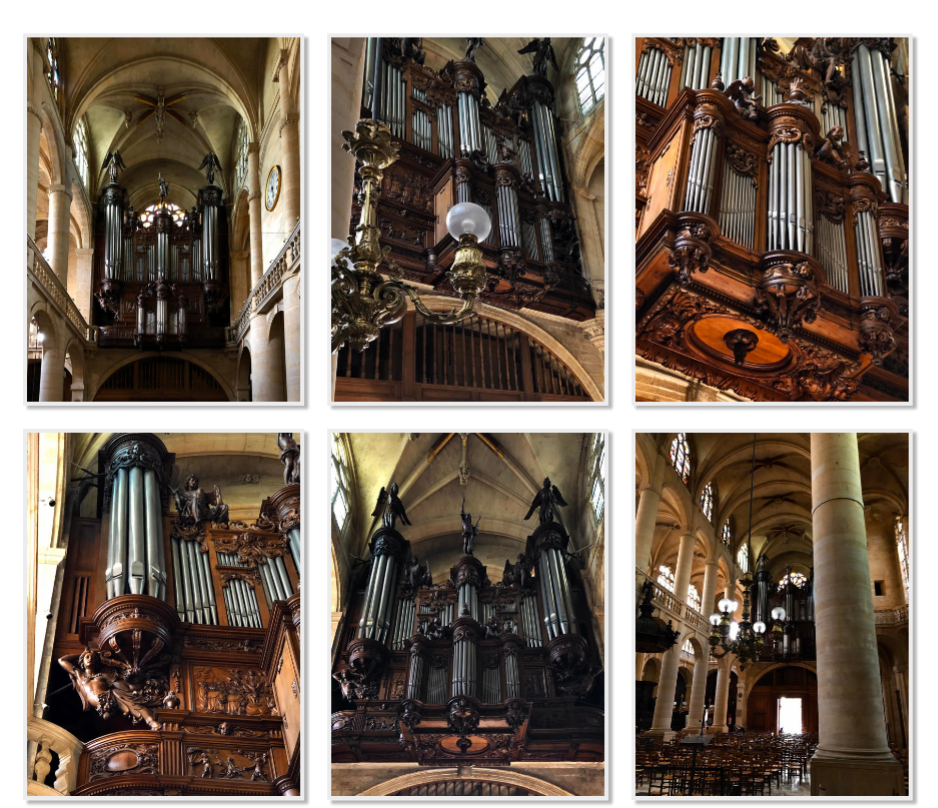
The present organcase of Saint Etienne du Mont dates from
1633 and was built by Jean Buron. It is a real masterpiece and
perhaps the most beautiful organ case in Paris and the oldest
case which is preserved completely.
It originally housed an instrument of 34 stops and 4 keyboards
of 48 notes and pedal of 32 notes (!) built by Pierre Pescheur
with a Plein Jeu X on the Great and VI on the Positif. Some of
the 16th century piping has been reused.
1656
Jean De Heman and Pierre Desenclos performed an overhaul.
1679
Overhaul by Jacques Carouge with the addition of two
pedalstops
1717
Julien Tribuot restored the five wedge-shaped bellows and
added Flute stops to the Pedal.
1766-1777
In July 1760, the organ was seriously damaged by a violent fire.
In 1766, Somer began its restoration. After his death in 1771,
François-Henri Clicquot took over the project, which would not
be completed until 1777.
•
Complete overhaul of the action and the wind system.
•
The manuals were extended to 50 notes (C¹–D⁵, without
C♯¹), and the pedalboard was enlarged in the bass (F⁰–C³).
•
The stops damaged by the fire were restored: the two
Montres (Positif and Grand-Orgue), the Plein Jeu ranks, and
the Grand-Orgue reeds.
•
Several changes were made on the Grand-Orgue: the 4′
Flute and the Cromorne were replaced by a Grosse Tierce
and a second Trompette, and an 8′ Flute (treble) was
added.
•
Addition of an 8′ Trompette on the Récit.
•
Clicquot rebuilt all the reed stops.
•
Clicquot also added an 8′ Hautbois to the Positif and
another to the Récit, replacing the former 8′ Trompette.
•
Clicquot added a 16′ Bombarde to the Pedal.
1807
Overhaul by Pierre François Dallery
1833
The organ was reinstalled by John Abbey. The bellows and
action were overhauled, and an expression box was added for
the stops of the Récit division.
1863-1873
Aristide Cavaillé-Coll rebuilt the organ. The number of
keyboards was reduced to three, including a completely new
Récit of 42 notes. A 16' Bombarde was added to the Great
Organ. The organ then included 39 stops.
1911
Théodore Puget carried out an overhaul of the organ,
extended the Récit to 50 notes and the pedalboard to 30
notes, and added five combination pedals.
In 1922, he installed an electric blower.
1928
Paul-Marie Koenig began a restoration and enlargement of the
instrument. However, the work was halted in 1929.
1956
Beuchet-Debierre completely rebuilt and significantly enlarged
the organ in a neo-classical style, under the supervision of its
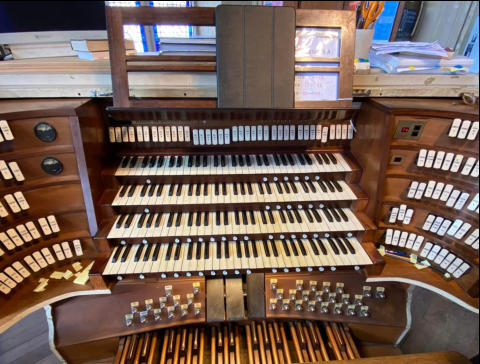
organist Maurice Duruflé. The instrument was expanded to 83
stops on four manuals and pedal. Around thirty stops,
including those of the Pedal division, are located outside the
main case. The key and stop action were electrified, and a new
detached console was installed on the north side gallery,
replacing the original console that had been placed between
the main case and the Rückpositiv.
1975
The zinc bass pipes were removed, the scaling of each stop
was revised, and the reeds were fitted with new tongues.
Several stops were also replaced:
Great: the Quint 2 2/3′ was replaced by a large two‑rank
Mixture.
Echo: an 8′ Trompette en chamade was added.
Pedal: a 32′ Bassoon was installed, with extensions at 16′, 8′,
and 4′.
1991
Restoration by Bernard Dargassies with some alterations of
harmony, in consultation with Marie Madeleine Duruflé.
2012
Overhaul by Dargassies .
39 stops date from before the revolution, but they are severely
modified (only 7 stops are still located on their original place); 6
stops date from Cavaillé-Coll.
More info
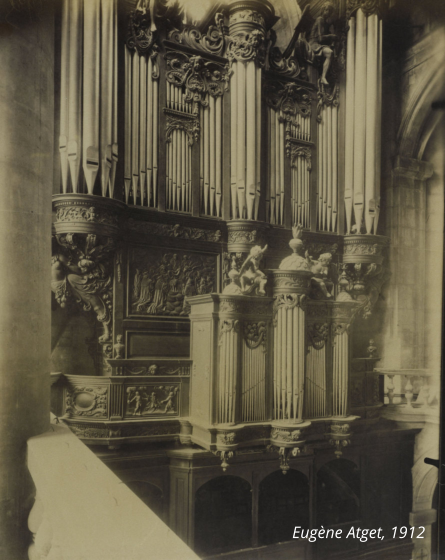
Photo of the church: Charles Aknin
St-Etienne-du-Mont was built between 1492 and 1626
as the church of an abbey dedicated to Saint
Geneviève, the patron Saint of Paris. One of its chapels
housed her reliquary, although her remains were
burned during the Revolution.
The site itself is much older, dating back to the 6th
century, when Clovis (466–511) founded the abbey.
Remains of the medieval buildings, located south of
the current church, include the Tour de Clovis (Tower
of Clovis, with its lower part dating from the 11th
century), the cloister (15th century), and the refectory
(1220), all now part of the Lycée Henri‑IV.
The church combines Gothic and Renaissance
architectural styles. The apse vaults were begun in
1491, the chancel completed in 1537, the gallery in
1545, and the vaults of the nave and transept finished
in 1580. The portal was built in 1610, and the bell
tower in 1624.
Particularly remarkable is the rood screen (jubé),
probably by Pierre Beaucorps around 1530, which
spans the nave like a bridge with spiral staircases on
each side — the only surviving example in Paris. The
wooden pulpit (1651) is supported by a figure of
Samson holding a jawbone, with a slain lion at his feet.
The fourth chapel on the right from the entrance
contains 16th‑century stained glass. In the mid‑19th
century, the Chapelle des Catéchismes was added.


1636 - Pierre Le Pescheur (1)
1656 - Jean de Héman & Pierre Désenclos (6)
1679 - J. Carouge (6)
1717 - J. Tribuot (6)
1766-77 - Somer/Clicquot (5)
1807 - Dallery (6)
1833 - Abbey (6)
1863-73 - Cavaillé-Coll (3a)
1911/22- Puget (5)
1928 - Koenig (6)
1956 - Beuchet-Debierre (3a)
1975 - Gonzalez (3a)
1989 - Dargassies (5)
2012 - Dargassies (6)
IV/89 (83) - traction électrique
Stoplist

Titular organist
Vincent Warnier & David Cassan
Organistes célèbres dans le passé : Guillaume Lasceux
(1774-1819), Maurice Duruflé (1929-1986), Marie-
Madeleine Duruflé-Chevalier ( 1947-1996), Thierry Escaisch
(1996-2024).
Concerts
le premier samedi du mois à 16h30
Parish website
Videos
Thierry Escaich: 4 improvisations
Vincent Warnier: improvisation
Pétur Sakari: improvisation
Pétur Sakari: Louis Vierne (Allegro Symphony 2)
Pétur Sakari: Jehan Alain (Litanies)
Marie-Madeleine Duruflé-Chevalier à l'Orgue de l'église
Saint-Etienne du Mont à Paris. Enregistré en 1961.
Marie-Madeleine Duruflé Chevalier à l'orgue de l'église
Saint-Etienne du Mont à Paris. enregistré en 1991.
Photo
Buffet : Jeroen de Haan
Eglise : Charles Aknin
Console: Thibault Hoch (facebook)








The organs of Paris


ORGANS OF PARIS © 2026 Vincent Hildebrandt
D5
Since around 1550 there was a small organ in this church
placed in a chapel in the south transept.
The present organcase of Saint Etienne du Mont dates from
1633 and was built by Jean Buron. It is a real masterpiece
and perhaps the most beautiful organ case in Paris and the
oldest case which is preserved completely.
It originally housed an instrument of 34 stops and 4
keyboards of 48 notes and pedal of 32 notes (!) built by
Pierre Pescheur with a Plein Jeu X on the Great and VI on the
Positif. Some of the 16th century piping has been reused.
1656
Jean De Heman and Pierre Desenclos performed an
overhaul.
1679
Overhaul by Jacques Carouge with the addition of two
pedalstops
1717
Julien Tribuot restored the five wedge-shaped bellows and
added Flute stops to the Pedal.
1766-1777
In July 1760, the organ was seriously damaged by a violent
fire. In 1766, Somer began its restoration. After his death in
1771, François-Henri Clicquot took over the project, which
would not be completed until 1777.
•
Complete overhaul of the action and the wind system.
•
The manuals were extended to 50 notes (C¹–D⁵, without
C♯¹), and the pedalboard was enlarged in the bass (F⁰–C³).
•
The stops damaged by the fire were restored: the two
Montres (Positif and Grand-Orgue), the Plein Jeu ranks,
and the Grand-Orgue reeds.
•
Several changes were made on the Grand-Orgue: the 4′
Flute and the Cromorne were replaced by a Grosse
Tierce and a second Trompette, and an 8′ Flute (treble)
was added.
•
Addition of an 8′ Trompette on the Récit.
•
Clicquot rebuilt all the reed stops.
•
Clicquot also added an 8′ Hautbois to the Positif and
another to the Récit, replacing the former 8′ Trompette.
•
Clicquot added a 16′ Bombarde to the Pedal.
1807
Overhaul by Pierre François Dallery
1833
The organ was reinstalled by John Abbey. The bellows and
action were overhauled, and an expression box was added
for the stops of the Récit division.
1863-1873
Aristide Cavaillé-Coll rebuilt the organ. The number of
keyboards was reduced to three, including a completely new
Récit of 42 notes. A 16' Bombarde was added to the Great
Organ. The organ then included 39 stops.
1911
Théodore Puget carried out an overhaul of the organ,
extended the Récit to 50 notes and the pedalboard to 30
notes, and added five combination pedals.
In 1922, he installed an electric blower.
1928
Paul-Marie Koenig began a restoration and enlargement of
the instrument. However, the work was halted in 1929.
1956
Beuchet-Debierre completely rebuilt and significantly
enlarged the organ in a neo-classical style, under the
supervision of its organist Maurice Duruflé. The instrument
was expanded to 83 stops on four manuals and pedal.
Around thirty stops, including those of the Pedal division,
are located outside the main case. The key and stop action
were electrified, and a new detached console was installed
on the north side gallery, replacing the original console that
had been placed between the main case and the
Rückpositiv.
1975
The zinc bass pipes were removed, the scaling of each stop
was revised, and the reeds were fitted with new tongues.
Several stops were also replaced:
Great: the Quint 2 2/3′ was replaced by a large two‑rank
Mixture.
Echo: an 8′ Trompette en chamade was added.
Pedal: a 32′ Bassoon was installed, with extensions at 16′, 8′,
and 4′.
1991
Restoration by Bernard Dargassies with some alterations of
harmony, in consultation with Marie Madeleine Duruflé.
2012
Overhaul by Dargassies .
39 stops date from before the revolution, but they are severely
modified (only 7 stops are still located on their original place); 6
stops date from Cavaillé-Coll.
More info

1636 - Pierre Le Pescheur (1)
1656 - Jean de Héman & Pierre Désenclos (6)
1679 - J. Carouge (6)
1717 - J. Tribuot (6)
1766-77 - Somer/Clicquot (5)
1807 - Dallery (6)
1833 - Abbey (6)
1863-73 - Cavaillé-Coll (3a)
1911/22- Puget (5)
1928 - Koenig (6)
1956 - Beuchet-Debierre (3a)
1975 - Gonzalez (3a)
1989 - Dargassies (5)
2012 - Dargassies (6)
IV/89 (83) - traction électrique
Stoplist
Titular organist
Vincent Warnier & David Cassan
Organistes célèbres dans le passé : Guillaume Lasceux (1774-
1819), Maurice Duruflé (1929-1986), Marie-Madeleine Duruflé-
Chevalier ( 1947-1996), Thierry Escaisch (1996-2024).
Concerts
le premier samedi du mois à 16h30
Parish website
Videos
Thierry Escaich: 4 improvisations
Vincent Warnier: improvisation
Pétur Sakari: improvisation
Pétur Sakari: Louis Vierne (Allegro Symphony 2)
Pétur Sakari: Jehan Alain (Litanies)
Marie-Madeleine Duruflé-Chevalier à l'Orgue de l'église
Saint-Etienne du Mont à Paris. Enregistré en 1961.
Marie-Madeleine Duruflé Chevalier à l'orgue de l'église
Saint-Etienne du Mont à Paris. enregistré en 1991.
Photo
Buffet : Jeroen de Haan
Eglise : Charles Aknin
Console: Thibault Hoch (facebook)

